|
|


|
|
Software & Languages
The RS-232-C standard for communication permitted computers and peripheral
devices to transmit information serially -- that is, one bit at a time. The
RS-232-C protocol spelled out a purpose for a serial plug's 25 connector pins.

|
|
|

Xerox
|
|
Companies
Xerox Corp. bought Scientific Development Systems for nearly $1 billion -- 90
times the latter's earnings. The SDS series of minicomputers in the early
1960s logged more sales than did Digital Equipment Corp. Xerox changed the
series to the XDS computers but eventually closed the division and ceased to
manufacture the equipment.
|
|
|
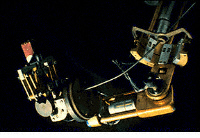 Stanford Arm
|
|
Robots & AI
Victor Scheinman's Stanford Arm made a breakthrough as the first successful
electrically powered, computer-controlled robot arm. By 1974, the Stanford Arm
could assemble a Ford Model T water pump, guiding itself with optical and
contact sensors. The Stanford Arm led directly to commercial production.
Scheinman went on to design the PUMA series of industrial robots for Unimation,
robots used for automobile assembly and other industrial tasks.
|
|
|
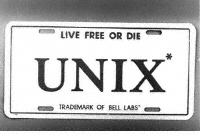 UNIX "license plate"
|
|
Software & Languages
AT&T Bell Laboratories programmers Kenneth Thompson and Dennis Ritchie
developed the UNIX operating system on a spare DEC minicomputer. UNIX combined
many of the timesharing and file management features offered by Multics, from
which it took its name. (Multics, a projects of the mid-1960s, represented the
first effort at creating a multi-user, multi-tasking operating system.) The
UNIX operating system quickly secured a wide following, particularly among
engineers and scientists.
|

|
|

|
|