

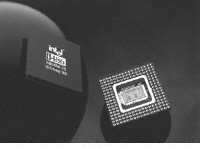
 Intel 80486
|
Components
Intel released the 80486 microprocessor and the i860 RISC/coprocessor chip,
each of which contained more than 1 million transistors. The RISC
microprocessor had a 32-bit integer arithmetic and logic unit (the part of the
CPU that performs operations such as addition and subtraction), a 64-bit
floating-point unit, and a clock rate of 33 MHz.
The 486 chips remained similar in structure to their predecessors, the 386
chips. What set the 486 apart was its optimized instruction set, with an
on-chip unified instruction and data cache and an optional on-chip
floating-point unit. Combined with an enhanced bus interface unit, the
microprocessor doubled the performance of the 386 without increasing the clock
rate.
|
|
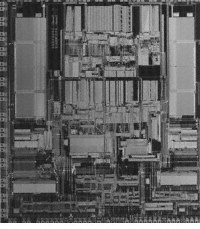 Motorola 68040
|
Components
Motorola announced the 68040 microprocessor, with about 1.2 million
transistors. Due to technical difficulties, it didn't ship until 1991,
although promised in January 1990. A 32-bit, 25-MHz microprocessor, the 68040
integrated a floating-point unit and included instruction and data caches.
Apple used the third generation of 68000 chips in Macintosh Quadra computers.

|
|
|
Software & Languages
Maxis released SimCity, a video game that helped launch of series of
simulators. Maxis cofounder Will Wright built on his childhood interest in
plastic models of ships and airplanes, eventually starting up a company with
Jeff Braun and designing a computer program that allowed the user to create his
own city. A number of other Sims followed in the series, including SimEarth,
SimAnt, and SimLife.
In SimCity, a player starts with an untouched earth. As the mayor of a city or
city planner, he creates a landscape and then constructs buildings, roads, and
waterways. As the city grows, the mayor must provide basic services like
health care and education, as well as making decisions about where to direct
money and how to build a revenue base. Challenges come in the form of natural
disasters, airplane crashes, and monster attacks.
|
||
|
Software & Languages
The concept of virtual reality made a statement as the hot topic at Siggraph's
1989 convention in Boston. The Silicon Graphics booth featured the new
technology, designed by the computer-aided design software company Autodesk and
the computer company VPL. The term describes a computer-generated 3-D
environment that allows a user to interact with the realities created there.
The computer must calculate and display sensory information quickly enough to
fool the senses.
Howard Rheingold described, "shared and objectively present like the
physical world, composable like a work of art, and as unlimited and harmless as
a dream." First practical for accomplishing such tasks as flight
simulation, virtual reality soon spread much further, promising new ground in
video games, education, and travel. Computer users are placed into the virtual
environment in a variety of ways, from a large monitor to a head-mounted
display or a glove.
|

|

|