

|
Networks
The modern Internet gained support when the National Science foundation formed
the NSFNET, linking five supercomputer centers at Princeton University,
Pittsburgh, University of California at San Diego, University of Illinois at
Urbana-Champaign, and Cornell University. Soon, several regional networks
developed; eventually, the government reassigned pieces of the ARPANET to the
NSFNET. The NSF allowed commercial use of the Internet for the first time in
1991, and in 1995, it decommissioned the backbone, leaving the Internet a
self-supporting industry.
The NSFNET initially transferred data at 56 kilobits per second, an improvement
on the overloaded ARPANET. Traffic continued to increase, though, and in 1987,
ARPA awarded Merit Network Inc., IBM, and MCI a contract to expand the Internet
by providing access points around the country to a network with a bandwidth of
1.5 megabits per second. In 1992, the network upgraded to T-3 lines, which
transmit information at about 45 megabits per second.
|
||
|
Components
Able to hold 550 megabytes of prerecorded data, the new CD-ROMs grew out of
regular CDs on which music is recorded. Their capacity is great enough that
they rarely fill up, even with information that would take up thousands of
pages of paper.
The first general-interest CD-ROM product released after Philips and Sony
announced the CD-ROM in 1984 was "Grolier's Electronic Encyclopedia,"
which came out in 1985. The 9 million words in the encyclopedia only took up
12 percent of the available space. The same year, computer and electronics
companies worked together to set a standard for the disks so any computer would
be able to access the information.
|
||
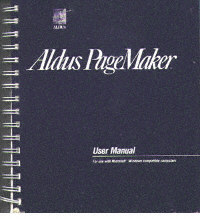 Aldus PageMaker
|
Software & Languages
Aldus announced its PageMaker program for use on Macintosh computers, launching
an interest in desktop publishing. Two years later, Aldus released a version
for IBMs and IBM-compatible computers. Developed by Paul Brainerd, who founded
Aldus Corp., PageMaker allowed users to combine graphics and text easily enough
to make desktop publishing practical.
Chuck Geschke of Adobe Systems Inc., a company formed in 1994 by the merger of
Adobe and Aldus, remembered: "John Sculley, a young fellow at Apple,
got three groups together - Aldus, Adobe, and Apple - and out of that came the
concept of desktop publishing. Paul Brainerd of Aldus is probably the person
who first uttered the phrase. All three companies then took everybody who
could tie a tie and speak two sentences in a row and put them on the road,
meeting with people in the printing and publishing industry and selling them on
this concept. The net result was that it turned around not only the laser
printer but, candidly, Apple Computer. It really turned around that whole
business."
|
|
|
Software & Languages
The C++ programming language emerged as the dominant object-oriented language
in the computer industry when Bjarne Stroustrup published "The C++
Programming Language." Stroustrup, at AT&T Bell Laboratories, said
his motivation stemmed from a desire to write event-driven simulations that
needed a language faster than Simula. He developed a preprocessor that allowed
Simula style programs to be implemented efficiently in C.
Stroustrup wrote in the preface to "The C++ Programming Language":
"C++ is a general purpose programming language designed to make
programming more enjoyable for the serious programmer. Except for minor
details, C++ is a superset of the C programming language. In addition to the
facilities provided by C, C++ provides flexible and efficient facilities for
defining new types.... The key concept in C++ is class. A class is a
user-defined type. Classes provide data hiding, guaranteed initialization of
data, implicit type conversion for user-defined types, dynamic typing,
user-controlled memory management, and mechanisms for overloading operators....
C++ retains C's ability to deal efficiently with the fundamental objects of the
hardware (bits, bytes, words, addresses, etc.). This allows the user-defined
types to be implemented with a pleasing degree of efficiency."
|


|

|